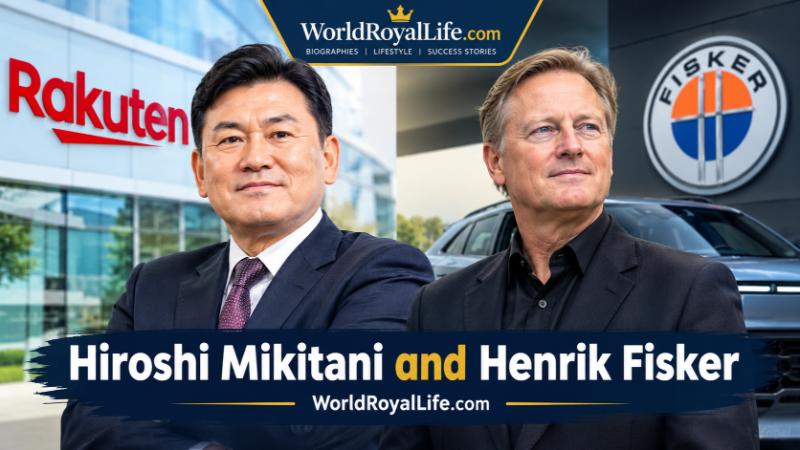
Hiroshi Mikitani and Henrik Fisker are entrepreneurs whose careers reveal two different sides of modern business. Mikitani built Rakuten into a diversified internet services group, while Fisker developed a reputation for luxury automotive design and electric vehicle ventures. Both pursued ambitious ideas, but their industries demanded different strategies, investments, and management skills.
The keyword Hiroshi Mikitani and Henrik Fisker brings together two business figures who are better understood through their individual achievements than through an assumed partnership. Their stories offer useful insights into entrepreneurship, family influences, innovation, and the challenges of building companies that can survive in competitive markets.
Who Is Hiroshi Mikitani?
Hiroshi Mikitani was born on March 11, 1965, in Kobe, Japan. He graduated from Hitotsubashi University and earned an MBA from Harvard Business School in 1993. Before entering entrepreneurship, he worked at the Industrial Bank of Japan. In 1997, Mikitani founded the company that became Rakuten Group. His original idea centered on helping merchants reach customers through an online marketplace. Rather than limiting the company to shopping, he expanded its business into financial technology, digital content, telecommunications, and other internet services.
Rakuten’s official founder profile describes an ecosystem spanning more than 70 services. This business model connects different services under a broader corporate structure, although each division faces its own competitive and financial pressures. Mikitani’s career demonstrates how an entrepreneur can use an established business to enter new markets. His leadership also shows the complexity of managing a large organization with interests across several industries.
Hiroshi Mikitani’s Family Background
Mikitani’s family background provides context for his education and entrepreneurial journey. His father, Ryōichi Mikitani, was an economist and academic who taught at Yale University. Harvard Business School’s biography also describes how the 1995 Kobe earthquake affected Mikitani and his family.
| Family detail | Publicly documented information |
|---|---|
| Full name | Hiroshi Mikitani |
| Date of birth | March 11, 1965 |
| Birthplace | Kobe, Japan |
| Father | Ryōichi Mikitani, economist and academic |
| Family’s connection to Kobe | His family lived in Kobe during the 1995 earthquake |
| Education | Hitotsubashi University and Harvard Business School |
| Spouse and children | Detailed information is not established in the official executive biography cited here |
His professional story reflects the influence of education, personal experiences, and entrepreneurial ambition. It is important to distinguish these documented details from private family information that reliable sources do not consistently confirm.
Who Is Henrik Fisker?
Henrik Fisker is a Danish automotive designer and entrepreneur born on August 10, 1963, in Allerød, Denmark. He studied automotive design at the ArtCenter College of Design and began his career at BMW in Germany. Fisker later worked with Ford and Aston Martin. His design career includes the BMW Z8 and work associated with the Aston Martin V8 Vantage and DB9. These projects helped establish his reputation in the premium automotive industry.
Fisker eventually moved from design leadership into company building. In 2007, he co-founded Fisker Automotive, which developed the Fisker Karma plug-in hybrid. The company filed for Chapter 11 bankruptcy protection in 2013. He subsequently co-founded Fisker Inc. in 2016 with his wife, Geeta Gupta-Fisker. The company developed the Fisker Ocean electric SUV, but financial and operational difficulties eventually led to another bankruptcy filing in June 2024.
Henrik Fisker’s Family and Business Partnership
Unlike many entrepreneurs whose family lives remain separate from their companies, Fisker had a documented professional partnership with his wife.
| Family detail | Publicly documented information |
|---|---|
| Full name | Henrik Fisker |
| Date of birth | August 10, 1963 |
| Birthplace | Allerød, Denmark |
| Wife | Geeta Gupta-Fisker |
| Wife’s business role | Co-founder of Fisker Inc. |
| Her executive responsibilities | Chief Financial Officer and Chief Operating Officer, according to company filings |
| Professional connection | Both participated in leading Fisker Inc. |
| Children’s private details | Not included because they are not necessary to explain the business history |
Fisker Inc.’s SEC proxy filing documents their marriage and professional roles. Their shared leadership illustrates how a family relationship can overlap with corporate responsibilities. It also highlights the importance of governance, financial controls, and clear accountability in a company facing significant business pressures.
Hiroshi Mikitani and Henrik Fisker Compared
Although both pursued innovation, their companies operated under very different conditions. Digital services can expand across markets without building a physical product for every customer, while automotive manufacturers must manage engineering, suppliers, production facilities, and vehicle safety.
| Business factor | Hiroshi Mikitani | Henrik Fisker |
|---|---|---|
| Nationality | Japanese | Danish |
| Main industry | Technology and internet services | Automotive design and electric vehicles |
| Major business | Rakuten Group | Fisker Automotive and Fisker Inc. |
| Professional starting point | Banking | Automotive design |
| Notable achievement | Developing a diversified digital ecosystem | Designing luxury vehicles and developing EV ventures |
| Business model | Connected digital services | Vehicle development and manufacturing |
| Major challenge | Managing expansion across multiple sectors | Financing, production, and scaling automotive operations |
This comparison is not a ranking of their careers. It explains why their business decisions and outcomes must be evaluated within their respective industries.
Why Did Their Business Paths Differ?
Mikitani’s business strategy focused on building an ecosystem. Rakuten expanded from e-commerce into services that can support customer relationships across several parts of the digital economy. This approach creates opportunities for cross-service growth, but it also requires investment and coordination.
Fisker’s career followed a product-led path. Automotive design can create a distinctive identity for a vehicle, but manufacturing requires additional capabilities. Companies must secure financing, manage supply chains, deliver vehicles on schedule, and support customers after a sale.
The bankruptcy of Fisker Automotive in 2013 and Fisker Inc. in 2024 demonstrates the difficulty of turning automotive ambition into a sustainable operating business. These outcomes should not be reduced to design alone; company finances, execution, market conditions, and operational decisions also matter.
Are Hiroshi Mikitani and Henrik Fisker Business Partners?
The public sources reviewed for this article do not establish a significant direct business partnership, shared company, or confirmed investment relationship between Mikitani and Fisker.
Their names are most accurately discussed together as a comparison of entrepreneurship in technology and automotive design. Presenting them as partners without credible evidence would mislead readers and weaken an article’s reliability.
Frequently Asked Questions
What is Hiroshi Mikitani famous for?
He is best known for founding Rakuten and developing it into a diversified internet services group.
What is Henrik Fisker known for?
He is known for automotive design work, including the BMW Z8, and for founding companies focused on premium and electric vehicles.
Who is Henrik Fisker’s wife?
His wife is Geeta Gupta-Fisker, who co-founded Fisker Inc. and held senior financial and operational positions.
Did Hiroshi Mikitani invest in Fisker Inc.?
The sources reviewed do not establish a significant direct investment by Mikitani in Fisker Inc.
What can entrepreneurs learn from their careers?
Their experiences show that innovation requires more than an appealing idea. Businesses also need sound financial planning, capable management, and an operating model suited to their industry.
Final Words
Hiroshi Mikitani and Henrik Fisker built their professional reputations through different forms of innovation. Mikitani expanded an online marketplace into a diversified digital business, while Fisker combined automotive design with attempts to establish electric vehicle manufacturers.
Their careers provide a useful comparison of business strategy, family involvement, and the challenges of scaling a company. The strongest lesson is that long-term business performance depends not only on vision, but also on execution, financial discipline, and the ability to adapt when conditions change. If you need more details to visit my blogs.